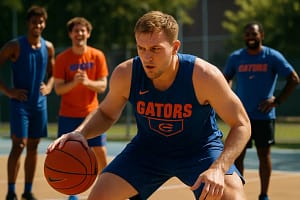
Artūras Butajevas gives Florida a freshman frontcourt profile built on size, rebounding production and a basketball education that started far from Gainesville. Florida men’s basketball officially signed him on April 27, 2026, and announced that he would join the Gators as a true freshman for the 2026-27 season team announcement. That matters because this is not just a roster addition on paper. It is a bet on a 6-foot-10, 235-pound forward/center from Klaipėda, Lithuania, whose junior international numbers already tell a clear story: he has lived around the rim, he has rebounded across age-group tournaments, and he has played meaningful basketball against strong competition before his first college practice became part of the public record.
For Florida fans, the appeal is easy to see. The Gators have long been at their best when the frontcourt does more than occupy space. Championship-level teams need bigs who run, screen, rebound, defend actions and punish soft possessions. But there is also a sober side to this signing. Butajevas has not yet played college basketball. His senior-pro record in Spain’s top division is tiny: Basketball-Reference lists two Liga ACB appearances, one with Barça and one with Unicaja, for three total minutes and no counting stats at that level international profile. So the right lens is development, not instant coronation.
Artūras Butajevas And Florida’s Frontcourt Bet
Why Artūras Butajevas Fits The Board
The case for Artūras Butajevas starts with his frame and his production. Florida listed him at 6 feet 10 inches and 235 pounds, with forward/center flexibility. That is the kind of size that lets a coaching staff ask real questions in practice: Can he hold ground on the block? Can he rebound outside his area? Can he defend without fouling? Can he run the floor hard enough to turn misses into early offense?
His work with Unicaja Málaga’s U22 squad in Spain during the 2025-26 season gives Florida a useful baseline. He averaged 15.6 points and 7.6 rebounds per game. Those numbers do not guarantee a college role, but they do show that he was not just a tall prospect waiting for a scholarship. He produced inside a European club setting, where young bigs often learn spacing, screening angles and team defensive habits before they learn how to market themselves.
That is why this commitment feels like a Florida basketball move rather than a headline grab. Gainesville cares about production, but it also cares about fit. A frontcourt player who can bring physical play, rebound and grow into multiple spots gives the staff options. He may not need to be the focal point right away to matter. He can help raise the practice standard, challenge older bigs and learn the pace of SEC basketball from the inside out.
The Rebounding Trail From FIBA Events
The best verified evidence in his profile comes from international youth competition. At the 2025 FIBA U18 EuroBasket, he averaged 13.9 points and 9.3 rebounds, with a 25-point, 16-rebound game against Greece. At the 2024 FIBA U17 World Cup, he averaged 14.4 points and 11.3 rebounds, posted three double-doubles, led all players in total rebounds and ranked second in rebounds per game. At the 2023 U16 European Championship, he averaged 15.6 points and 9.9 rebounds, with three double-doubles, including 23 points and 14 rebounds in the bronze medal game against France.
That run of numbers is not accidental. Rebounding is usually one of the cleaner skills to translate because it tests timing, contact, pursuit and want-to. You can fake a hot shooting week. It is harder to fake tournament after tournament of board work. Florida’s coaches described him as a physical and athletic frontcourt presence with strong rebounding and versatility. That description lines up with the box scores more than it sells a dream.
For a shorter snapshot of the signing, our earlier Butajevas commitment note framed the move through the lens of frontcourt depth and summer development. The deeper takeaway is that Florida did not simply add height. It added a young big with a documented pattern: he gets on the glass, he scores enough to draw attention, and he has been tested in age-group international games.
What His Game Could Add To Florida
Physicality Before Polish
Every freshman big arrives with a checklist. For Butajevas, the first item is likely physical adjustment. The research record points to a player with size, athletic tools and rebounding habits, but also one who may need to add strength and consistency. That is not a flaw as much as it is the normal price of moving from youth and club settings into SEC practices.
Florida’s mid-July 2026 summer workout emphasis for its freshman frontcourt group included physicality, speed, defensive awareness and box-outs. That tells you how the staff saw the transition. The first stage is not about designing a dozen touches. It is about building daily habits that hold up when the game gets faster, louder and more physical.
There is a community angle here, too. Gainesville fans tend to appreciate big men who do unglamorous work. A hard box-out in November can become a trusted postseason possession months later. A freshman who learns to sprint back, wall up and end a possession with two hands on the ball can earn credibility before his offensive game is fully formed.
Bench Role With Growth Potential
The fairest expectation is a patient one. The available research suggests he may begin more as a depth piece than as a guaranteed featured option. That is not a slight. On a serious roster, the fourth big can still matter. Foul trouble happens. Matchups shift. Practices need competition. A team with championship hopes cannot survive on two frontcourt players and optimism.
His offensive profile should be judged with care. The official notes point to scoring production at youth and U22 levels, but they also mention the need for consistency, especially with outside shooting mechanics. So the early college version may be at his best near the rim: screen, seal, run, rebound and finish. If the jumper comes along, the ceiling changes. If it takes time, he can still carve a path through defense and glass work.
That balance is what makes Artūras Butajevas interesting. He is not being introduced as a finished star. He is being introduced as a freshman with tools and evidence. Coaches love that kind of file because it leaves room for teaching. Fans should like it because development stories are part of what makes college basketball feel local and personal. You watch the footwork improve. You notice the stronger screens. You remember the first night when the game slows down for him.
How The Fit Shapes Team Dynamics
Competition Inside Practice
Roster depth changes more than game minutes. It changes Tuesdays and Wednesdays, when players see the same actions over and over until habits are either exposed or strengthened. A 6-foot-10 freshman who rebounds with force can make teammates sharper. Guards learn to finish against length. Other bigs feel contact on every rep. Coaches get more choices when building lineups.
Florida’s frontcourt identity will not be decided by one newcomer, but he can influence it. If he rebounds at the level his international record suggests, he gives the staff another body capable of ending defensive possessions. That matters in a conference where missed box-outs become dunks, and where a small lapse can swing a road half.
There is also a cultural piece. International freshmen often bring different training rhythms and game backgrounds. Butajevas arrives from Lithuania by way of Spain’s development structure. That does not make him better or worse than a domestic recruit. It gives Florida a different kind of freshman story, one shaped by FIBA tournaments, club basketball and a move into the American college game.
Why Patience Is Part Of The Evaluation
It is tempting to read junior international stats and rush straight to big projections. That would miss the point. The verified record gives Florida reason to invest time. It does not remove the adjustment period. The SEC will test his strength, decision-making, foot speed and foul discipline. College spacing will test where he is most comfortable on offense. The staff’s teaching will decide how quickly the tools become dependable minutes.
This is where Todd Golden’s program can turn a signing into a story. The goal is not to win the press release. The goal is to build a player who can help win possessions. If Butajevas becomes reliable on the boards and holds his defensive spots, the Gators have a useful frontcourt piece. If the offensive touch carries over and the shooting mechanics settle, the upside grows.
For Florida’s basketball community, that is the fun part. The player who signs in April is rarely the same player fans see by February. Strength work, film sessions, scout-team battles and early mistakes all shape the arc. In a college town, those steps do not happen in silence. They become part of the season’s weekly conversation.
What Artūras Butajevas Means For Gainesville
Artūras Butajevas means Florida has added a true freshman big with verified rebounding production, real size and a development curve worth tracking. He also gives the Gators another international thread in a roster story that keeps stretching beyond state lines while staying rooted in Gainesville expectations.
The most honest read is this: Florida signed a frontcourt prospect who has done serious work in youth international competition, but who still has to prove how quickly that work travels to college basketball. His senior Liga ACB sample is too small to make sweeping claims. His FIBA and U22 production, though, is strong enough to explain why the Gators wanted him in the building.
If he earns early minutes, they may come through rebounding, energy and defensive growth before polished scoring. If he needs time, that is still a reasonable path for a freshman forward/center. Either way, his arrival gives Florida more size, more competition and one more player-development story for a fan base that knows frontcourt depth can become championship detail when March possessions get tight.
