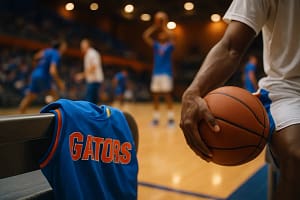
Gators NBA Prospects sit at the center of one of Florida basketball’s most compelling player-development stories entering the 2026-27 season. Thomas Haugh, Alex Condon and Rueben Chinyelu gave the Gators a frontcourt core that mixed production, size, defensive value and professional projection during the 2025-26 campaign. By September 19, 2026, the conversation had shifted from whether Florida had high-end college frontcourt talent to how that talent might translate when NBA decision-makers study the next draft class.
For a Gainesville basketball community that still measures eras by banners, postseason runs and pro pipelines, this group matters because it connects two threads at once: winning now and preparing players for the next level. Haugh’s scoring jump, Condon’s all-around frontcourt skill and Chinyelu’s rebounding defense gave Florida three very different NBA case studies. None of them needs to be forced into the same mold, and that is what makes the group so useful to evaluate.
Gators NBA Prospects And The Gainesville Standard
Why Gators NBA Prospects Stayed In Gainesville
The first part of the story is choice. Haugh declined to enter the 2026 NBA Draft and returned to Florida for his senior season. Condon also announced his return for the 2026-27 season. Chinyelu tested the draft process after declaring on April 20, 2026, while maintaining college eligibility, then remained part of the frontcourt picture for the next Florida team. Those decisions kept the Gators from starting over in the paint and gave the coaching staff a rare level of continuity with proven starters.
That continuity has real basketball value. College frontcourts often reset through graduation, transfer movement or early NBA entry. Florida’s group did not. Haugh, Condon and Chinyelu entered the next phase with a shared understanding of spacing, defensive coverage, rebounding lanes and how each player’s strengths can cover another’s pressure points. For a team trying to maintain a championship standard after winning the 2025 NCAA Tournament and the 2026 SEC regular-season championship, that kind of carryover can shape practices long before it shows up in a box score.
There is also a community angle that should not be brushed aside. Gainesville fans had already seen this group grow through high-stakes games. When players with NBA interest return, the home crowd gets more than another season of familiar names. It gets a chance to watch refinement in real time: cleaner reads, stronger defensive habits, better screening angles and more mature shot selection. For Gators NBA Prospects, that development can be as important as another line on a scouting report.
Production That Matches The Pro Attention
Thomas Haugh’s Scoring Profile
Haugh’s junior season supplied the cleanest scoring case in the group. In 34 starts during 2025-26, he averaged 17.1 points and 6.1 rebounds per game, according to Florida’s official 2025-26 statistics. Those numbers matter because they show volume and responsibility, not just flashes. Haugh was not being evaluated only as a complementary player; he produced like a primary college option on a high-level team.
His All-America and All-SEC recognition, as noted in the research, matched what the production suggested. The NBA projection begins with size and scoring touch, but it cannot stop there. For Haugh, scouts will want to see whether his senior season brings sharper passing decisions against loaded coverages and steadier defensive work in space. A player projected near the top of a draft needs more than points. He needs a role that can survive when the ball is not in his hands.
Alex Condon’s Two-Way Value
Condon’s case is different and, in some ways, broader. Across 34 starts in 2025-26, he posted 15.1 points, 7.5 rebounds and 3.6 assists per game while shooting .556 from the field and about 30 percent from three-point range, per the same Florida statistics page. That passing number stands out. Frontcourt players who can score, rebound and keep the offense moving are easier to fit into pro systems because they reduce the need for rigid play design.
Condon’s next layer is perimeter consistency. A 30 percent three-point mark does not close the book on his shooting profile, but it gives NBA scouts a clear development area to track. If his touch stretches defenses with more confidence, his value grows. If he remains most effective inside the arc, his passing and finishing still give him a path, but the spacing questions become louder. That is the appeal of his return to Florida: more game reps, more film and more chances to answer those questions while playing meaningful basketball.
How Chinyelu Changes The Frontcourt Math
Defense, Rebounding And A Clear NBA Skill
Chinyelu brings the most defined specialty of the trio. The research notes credit him with 10.9 points and 11.2 rebounds per game in 2025-26, along with a Florida single-season record of 137 offensive rebounds. He also received major defensive recognition, including SEC Defensive Player of the Year and national defensive honors from Naismith and NABC. Even without dressing that up, the profile is obvious: he changes possessions through glass work, size and rim protection.
That type of skill can travel. NBA teams do not ask every second-unit big or developmental center to create offense. They do ask them to defend actions, finish plays, set hard screens, rebound outside their area and avoid mistakes that lead to quick substitutions. Chinyelu’s draft range may not match Haugh’s or Condon’s in early projections, but he may own the clearest single calling card.
- Haugh: scoring forward with a chance to rise if his all-around reads keep improving.
- Condon: skilled frontcourt connector whose passing and efficiency give him first-round appeal.
- Chinyelu: defensive and rebounding anchor with a pro fit built around physical reliability.
The trio also helps each other. Haugh benefits from playing next to a rebounder who can extend possessions. Condon benefits from having another interior presence who draws defensive attention. Chinyelu benefits from teammates who can score enough to keep him from being judged only through post touches. For Gators NBA Prospects, the shared environment may be just as valuable as individual workouts.
Draft Signals Around Florida’s Big Three
What Early 2027 Projections Say
Early 2027 draft attention has been strong. Yahoo Sports, referencing ESPN’s mock draft work, reported Haugh as high as No. 7 and Condon around No. 17 in early projection ranges, while Chinyelu’s profile remained tied more closely to second-round discussion after his 2026 draft process early mock draft projections. Mock drafts in September 2026 are not final verdicts, but they do show how NBA evaluators and draft analysts are framing Florida’s frontcourt before the college season adds new evidence.
The 2007 comparison is hard to ignore because Florida once sent Al Horford, Corey Brewer and Joakim Noah into the first round from the same championship-era core. The current group has not matched that draft result, and it would be unfair to write it as destiny. Still, the possibility gives the 2026-27 season a sharper edge for local fans. Every SEC road game, every matchup against length, every late-clock possession and every defensive switch will feed the same question: how much of this production is college dominance, and how much is NBA-ready skill?
That is where Florida’s player development reputation gets tested in a positive way. Haugh needs to prove that his offensive growth can stand up against targeted scouting. Condon needs to keep blending efficiency with playmaking. Chinyelu needs to show he can defend without fouling and finish enough plays to stay on the floor. The answers will come through games, not projection boards.
Why Gators NBA Prospects Matter To Gainesville
From College Frontcourt To Pro Pipeline
The best part of this story is that it remains rooted in the team. The NBA angle is powerful, but Florida’s 2026-27 frontcourt value starts with how these players help the Gators win possessions. Rebounding travels. Interior defense travels. Smart passing travels. Those traits matter in the SEC before they matter in the draft room.
For the fan base, the focus should be clear: enjoy the basketball first, then let the draft talk follow the film. Haugh, Condon and Chinyelu give Florida a rare mix of star power and lineup balance. Their choices to stay connected the program’s present to its pro future, and that connection gives Gainesville a season of close study, not just celebration. Readers tracking how Florida builds around size and continuity can also follow the program’s frontcourt direction through this related look at Gators frontcourt newcomers.
If the group keeps improving, Gators NBA Prospects will be more than a draft label. It will describe a player-development moment where Florida’s college goals and professional ambitions moved together. That is the kind of basketball story this community understands: banners matter, but so does the work that sends players from Gainesville into the next stage prepared to compete.
