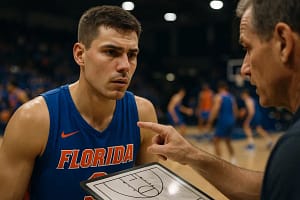
The Artūras Butajevas commitment gives Florida another young frontcourt piece with size, international production, and a clear path into Todd Golden’s roster competition for 2026-27. For a Gators program trying to keep its frontcourt stocked with length and rebounding, this is not just another name on a signing sheet. It is a player profile that fits the way modern college basketball asks big forwards to run, rebound, finish, and learn quickly.
Head coach Todd Golden announced the signing on April 27, 2026. Florida’s announcement lists Butajevas at 6-foot-10, quotes Golden calling him a “physical and athletic frontcourt player,” and details his production in youth international events and with Unicaja Malaga’s U22 team Florida’s announcement. That is the verified foundation for the story. The rest is about fit, timing, and what Gator fans should watch as another overseas prospect steps into Gainesville’s basketball routine.
Artūras Butajevas Commitment And Frontcourt Fit
Why Artūras Butajevas Commitment Matters Up Front
The Artūras Butajevas commitment matters because Florida is not adding a guard-sized project and hoping he grows into a role. Butajevas already brings a listed 6-foot-10 frame, and his production has come in settings where rebounding and physical play are not optional. In the college game, especially in conference play, frontcourt depth can swing a rotation. Foul trouble, matchup changes, and short-rest stretches all test whether a team has enough bodies who can handle contact.
From a commentator’s seat, the first thing that stands out is not just height. It is the repeat pattern in the numbers: points and rebounds showing up across multiple international age groups. Young bigs can sometimes post one strong tournament and then fade when the competition adjusts. Butajevas’ profile, based on the official figures available, shows production at U16, U17, and U18 levels, then with Unicaja Malaga’s U22 team in Spain. That does not guarantee a college role, but it does give Florida a cleaner evaluation base than pure projection.
The Kind Of Role Florida Can Test Early
Golden’s comment about physical and athletic frontcourt play points toward the first lane Butajevas may have to earn: compete on the glass, run the floor, finish plays created by guards, and hold defensive position without reaching. Those tasks sound simple until a freshman big faces stronger players, faster ball movement, and the daily pace of college practices.
Florida does not need to declare him a finished product before he arrives in full game action. A fair read is that he gives the staff another workable frontcourt option, and that matters in a program where competition inside the practice gym can shape who is trusted once the lights come on. The Artūras Butajevas commitment adds to that internal push.
International Production Gives Florida A Clear Baseline
FIBA Numbers With Rebounding Weight
Butajevas’ international production is the core of his recruiting case. At the 2025 FIBA U18 EuroBasket, he averaged 13.9 points and 9.3 rebounds per game. That event also included a 25-point, 16-rebound performance against Greece. At the 2024 FIBA U17 World Cup, he averaged 14.4 points and 11.3 rebounds per game. At the 2023 FIBA U16 European Championship, he posted 15.6 points and 9.9 rebounds per game.
Those rebounding averages are worth slowing down on. Scoring can be shaped by usage, matchups, and team style. Rebounding travels a little more cleanly because it usually reflects timing, effort, hands, and willingness to absorb contact. For Florida, that is a useful set of clues. Gainesville has seen plenty of frontcourt players grow into larger roles after first proving they could defend and rebound. Butajevas’ numbers suggest he has at least been comfortable making his presence felt near the rim.
| Stage | Reported Production | What It Suggests |
|---|---|---|
| 2025 FIBA U18 EuroBasket | 13.9 points, 9.3 rebounds per game | Strong scoring-rebounding balance against age-group peers |
| 2024 FIBA U17 World Cup | 14.4 points, 11.3 rebounds per game | Double-digit rebounding at a global youth event |
| 2023 FIBA U16 European Championship | 15.6 points, 9.9 rebounds per game | Early production before the later U17 and U18 events |
| 2025-26 Unicaja Malaga U22 | 15.6 points, 7.6 rebounds per game | Club-level output before joining Florida |
Unicaja Malaga U22 Context
The 2025-26 season with Unicaja Malaga’s U22 team adds another layer. Florida’s official information credits Butajevas with 15.6 points and 7.6 rebounds per game in that setting. Club development in Europe can expose young players to structured systems, older practice habits, and more tactical spacing than many age-group tournaments. We should be careful not to overstate that translation, because college basketball has its own speed and pressure. Still, a player coming from a club setting may arrive with a different practice background than a more traditional high school prospect.
This is where the scouting value sits for Florida fans. The Artūras Butajevas commitment is not built only on measurements. It is built on a pattern of competitive work before he joins the SEC grind. The staff will still have to see how he handles pace, communication, strength demands, and defensive reads once he is in the Gators’ system.
Summer Workouts And Roster Competition
How Young Forwards Can Push Each Other
The research notes for this story state that Butajevas participated in summer workouts with the Gators, a meaningful early step for any freshman frontcourt player. Summer is where terminology gets learned, conditioning standards get introduced, and teammates start to understand who can process instruction while tired. For bigs, it is also where coaches can start shaping footwork, screening angles, and defensive positioning before the full season rhythm takes over.
His arrival also sits inside a young frontcourt group that includes fellow freshmen forwards Domen Petrovic and Jones Lay. We have already taken a closer site-level look at Domen Petrovic’s arrival, and Butajevas gives that same group another angle: international size with proven rebounding numbers. Competition among freshmen can be healthy when roles are earned clearly. One player may bring shooting touch, another may bring screening, another may bring defensive instincts. The coaching staff’s job is to sort those traits into lineups that can survive real possessions.
Golden’s Recruiting Pattern
The Gators’ pursuit of international frontcourt players also fits the broader roster-building conversation around Todd Golden. College basketball staffs are no longer limited to one recruiting lane. High school prospects, transfers, and overseas players can all fill different needs. For readers tracking that bigger plan, our breakdown of Florida Gators men’s basketball recruitment connects to the same question: how does Florida keep enough playable depth while still giving young players room to grow?
The answer will not come from a signing announcement alone. It will come through practice habits, lineup trials, and how quickly new players absorb the staff’s expectations. The Artūras Butajevas commitment gives Florida a player worth developing, but the day-to-day competition will decide how soon he helps in games.
Why Gainesville Should Track This Frontcourt Addition
What Fans Can Watch First
For the Gainesville basketball community, the most practical way to track Butajevas is to watch the basics before chasing big projections. Does he rebound outside his area? Can he defend without fouling? Does he set contact screens? Can he finish through traffic? Does he communicate in the half court? Those details often decide whether a young forward gets trusted before his offensive skill set fully opens up.
The Artūras Butajevas commitment also gives fans another example of Florida looking beyond the familiar recruiting map. Lithuanian basketball has long been associated with skill, toughness, and frontcourt feel, but the only fair claim here is the one supported by the player’s verified résumé: Butajevas has produced in international youth competition and in Spain’s U22 setting before joining the Gators.
That is enough to make his first season in Gainesville worth watching closely. Not with wild predictions, and not with pressure to become a star right away. The more grounded view is better: Florida has added a 6-foot-10 forward with a record of scoring and rebounding against respected youth competition. If that translates into practice reliability, defensive growth, and frontcourt minutes, Gator fans will have another young player to follow from his first steps on campus toward a possible larger role in orange and blue.
