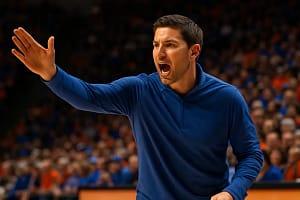
Todd Golden Leadership became more than a talking point on August 28, 2026, when Florida rewarded its men’s basketball coach with a six-year extension through the 2031-32 season. The deal, valued at $49.5 million, gave the Gators a public marker of trust after a four-year surge that included a national championship, SEC control, and a winning pace few coaches in school history have matched.
For a Gainesville community that measures basketball eras by banners, guard play, defensive toughness, and March composure, the extension was not just about salary. It was about the program’s belief that Golden’s voice had become strong enough to carry recruiting rooms, locker-room standards, and the daily habits that turn a talented roster into a connected team.
Todd Golden Leadership After The Extension
Todd Golden Leadership In Contract Terms
On August 28, 2026, Golden agreed to a six-year extension through the 2031-32 season worth $49.5 million, an average of $8.25 million per year, according to CBS Sports. Todd Golden Leadership, in practical terms, now sits inside one of the strongest program commitments Florida could make to a basketball coach.
The contract length matters because college basketball stability is harder to hold than it was even a few recruiting cycles ago. Rosters change quickly. Player retention requires honest roles, staff consistency, and a development plan that makes sense to players and families. Florida’s decision said that Golden’s system had earned time, not just praise after a hot run.
The buyout structure also showed how firmly the school tied itself to the coach. CBS Sports reported that if Golden were fired without cause, Florida would owe 85 percent of the remaining value. That kind of protection is not a casual reward. It is a signal that the Gators wanted their coach positioned as a long-term builder, not a short-term caretaker.
Why The Timing Carried Weight
The date of the agreement matters. Florida had already completed the 2025-26 season before the extension was announced, so the school was judging a full body of work rather than reacting to a single week in March. The 2024-25 title season had raised the ceiling. The 2025-26 campaign tested whether the program could remain near the top after the glow of a championship.
For fans in Gainesville, that distinction is personal. Championship teams create memories, but sustained programs create expectations. Golden’s extension landed after Florida had already shown it could win big, absorb the next wave of pressure, and stay near the front of the SEC race. That is why the contract read less like a celebration and more like a challenge accepted.
What The Record Says About Control
Four Seasons, 103 Wins
Florida’s official coach bio lists Golden at 103-41 overall and 50-22 in SEC play through his first four seasons with the Gators, with those 103 wins standing as the most by any Florida head coach in his first four seasons official coach bio. That record does not tell every story, but it gives the baseline: Florida has been winning often enough for the numbers to demand respect.
The 2024-25 season was the peak of that first chapter. Florida went 36-4, finished 14-4 in SEC play, won the SEC regular season, and captured the NCAA national championship. That mix of league success and national finish is rare air. It requires guard steadiness, frontcourt reliability, bench trust, and late-game decision-making from the staff.
The 2025-26 season had a different shape. Florida finished 27-8 with a 16-2 SEC record and reached the second round of the NCAA Tournament. A second-round exit after a No. 1 seed brings fair frustration in a place with championship standards, but the 16-2 SEC mark showed that the week-to-week foundation had not cracked. That is where Todd Golden Leadership separates itself from a single postseason result: the league grind still reflected control.
Top-Seed Pressure And Program Memory
Florida earned back-to-back No. 1 seeds in the NCAA Tournament in 2025 and 2026. According to the school’s bio, that doubled the program’s previous total of No. 1 seeds, which had come in 2007 and 2014. That stat matters because seeding is a season-long judgment. It reflects nonconference scheduling, conference consistency, injury response, road performance, and the selection committee’s view of a team’s full profile.
Golden’s Gators also logged 25 wins against Top-25 opponents and seven NCAA Tournament wins through the end of 2025-26, ranking second in school history behind Billy Donovan in both categories. Any Florida coach works under the shadow of Donovan’s banners, and Golden has not erased that shadow. He has done something more useful: he has built a modern comparison point that can live beside it.
Player Development And Team Continuity

Retaining Belief After A Title
Leadership after a championship can be harder than leadership before one. Before a title, the message is hunger. After a title, the message becomes standard. Golden returned a large share of scoring from the 2025 national championship group for the 2025-26 season, including frontcourt players Rueben Chinyelu, Alex Condon, and Thomas Haugh, based on the research record. That return production gave Florida a rare bridge from celebration to accountability.
For a coach, keeping the core engaged after a title requires more than reminding players about rings. Roles can change. Opponents adjust. Younger players want minutes. Veterans want growth, not repetition. The staff’s job is to keep the gym honest: compete daily, defend with purpose, rebound through contact, and accept that last season’s success does not win the next possession.
That is why the extension speaks to player development as much as wins. Florida’s frontcourt identity under Golden has been tied to size, activity, and lineup flexibility. The program’s ability to keep key contributors involved after a championship season suggested that players saw a path, not just a trophy case.
Community Confidence Around The Program
Gators basketball is not an isolated campus product. It touches local businesses on game nights, youth players in North Central Florida, alumni returning to Exactech Arena, and families who plan winter weekends around SEC play. A long contract does not guarantee wins, but it gives the community a clear name and structure to rally around.
That clarity matters in recruiting, too. A coach with a contract through 2031-32 can sit with a prospect and speak from a position of security. Assistants can sell continuity. Current players can describe a program that knows what it expects from practice, film, strength work, and classroom conduct. For readers tracking the program’s long runway, our deeper breakdown of the Todd Golden extension connects the contract to Florida’s wider roster-building plan.
Todd Golden Leadership And Gainesville’s Standard
For Gainesville, Todd Golden Leadership now carries a clear burden: turn a brilliant four-year opening act into a durable era. The numbers have already moved him into rare company at Florida. The title gave the program a banner. The SEC marks showed weekly authority. The extension made the school’s belief official.
The next measure is not a slogan. It is whether Florida keeps stacking the habits that made the contract possible: strong scouting, honest player roles, hard defensive possessions, high-level rebounding, and enough offensive trust to survive pressure games. Golden’s best teams have looked organized without playing stiff, confident without playing loose. That balance is difficult, and it is the work that separates a good coach from a program leader.
There is also a human side to the deal. Players in the locker room now know the head coach is not a temporary figure. Recruits know the pitch has institutional backing. Fans know the school chose continuity over uncertainty. In college basketball, that kind of alignment can be powerful when it is matched by daily standards.
Golden’s extension did not finish the story of Florida basketball. It sharpened the expectations around it. The Gators have already seen what his leadership can produce: 103 wins in four seasons, SEC control, back-to-back No. 1 seeds, and a national title. The task after August 28, 2026, became sustaining that level with the same edge that created it.
