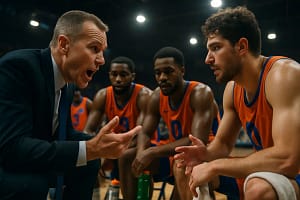
Roster Changes define the first read on the 2026-27 NBA season because talent alone rarely tells the full story. For Gators fans who track former college standouts into the pro game, the lesson is familiar: roles, spacing, leadership, and trust often decide how fast a group becomes a team. The NBA’s July 2026 continuity numbers put that idea in plain view, especially with Los Angeles at one end of the scale and New Orleans at the other.
As Mark Collins would put it from the broadcast table, a new locker room is not built during the opening tip. It is built through repeated possessions, late-clock decisions, defensive calls, and the simple question of who knows where the next pass should go. That is why continuity matters to Florida basketball people. Gainesville has always valued players who can fit inside a structure, grow through coaching, and carry that understanding forward.
How Roster Changes Reset Roles
Roster Changes And The Lakers Example
The sharpest 2026-27 case sits in Los Angeles. On July 10, 2026, NBA.com reported that the Lakers had the league’s lowest roster continuity: only four of their ten players who logged at least 700 regular-season minutes in 2025-26 remained under contract for 2026-27, representing just 42% of the team’s minutes from the previous season, according to NBA.com’s free agency analysis.
That number says plenty before any preseason possession is played. A club can add shooting, size, and defensive tools, but the staff still has to assign touches, identify closing groups, and build communication habits. The Lakers’ reported shift included Walker Kessler arriving through a sign-and-trade for $130 million over four years, plus additions such as Quentin Grimes, Collin Sexton, and Sandro Mamukelashvili. At the same time, Deandre Ayton, Luke Kennard, Marcus Smart, and others were listed among the departures.
Roster Changes do not automatically mean decline. They mean the coaching staff starts with a longer checklist. A center joining a new system has to learn the timing of guards on handoffs. Shooters need to learn which drives create corner looks. Defenders need to agree on coverage calls before the game speeds up. The Lakers may have gained certain skills, but their early challenge was always going to be shared timing.
Continuity As A Competitive Edge
New Orleans offered the other side of the argument. The same July 10 report placed the Pelicans among the league’s highest-continuity teams, with players under contract for 2026-27 accounting for 93% of their 2025-26 minutes. San Antonio was listed at 92%, Orlando at 90%, and New York at 88%.
Those figures do not guarantee wins, but they reduce the number of basketball questions that must be answered in October. Returning groups usually have clearer role memory. A guard knows where a wing likes the ball. A big man knows when the weak-side help is coming. Bench units know which player settles the possession after a broken play. In a long season, those small bits of understanding can show up in late quarters and back-to-backs.
For Florida fans, that should sound familiar. College programs talk about roster depth for a reason, and the same team-building theme appears in the Gators’ own 2026-27 conversation around Gators roster depth. The levels are different, but the basketball truth holds: returning minutes help coaches teach faster and adjust with less noise.
What Continuity Means On The Floor
Leadership Changes Show Up Early
Every roster with turnover has a leadership gap to settle. It may not be about who gives speeches. More often, it is about who calls the coverage, who stops a bad shot, who organizes the huddle after a 9-0 run, and who gets a younger teammate into the right spot. The box score rarely captures those moments, but coaches see them on film.
The Lakers’ 42% returning-minute figure points to a team that had to rebuild a good portion of its internal language. The Pelicans’ 93% figure points to a group that could spend less time introducing concepts and more time sharpening them. That contrast is exactly why July roster math matters months later. Continuity gives a team a head start. Turnover gives a team a wider range of possible outcomes.
Spacing And Defensive Trust Need Repetition
Spacing is not just a diagram. It depends on timing. If a driver expects the corner filled and the shooter lifts instead, the possession changes. If a screener flips the angle too early, the ball-handler loses the lane. If a weak-side defender rotates half a beat late, the entire shell breaks.
That is where returning groups often benefit. New York at 88%, Orlando at 90%, San Antonio at 92%, and New Orleans at 93% entered 2026-27 with more shared court memory than teams that made heavier changes. Coaches still have to improve those teams, but they can build from known habits. In Los Angeles, the staff had to blend new personnel with a lower returning-minute base, which placed extra value on training camp communication and early-season patience.
The Gators Lens On Pro Team Building
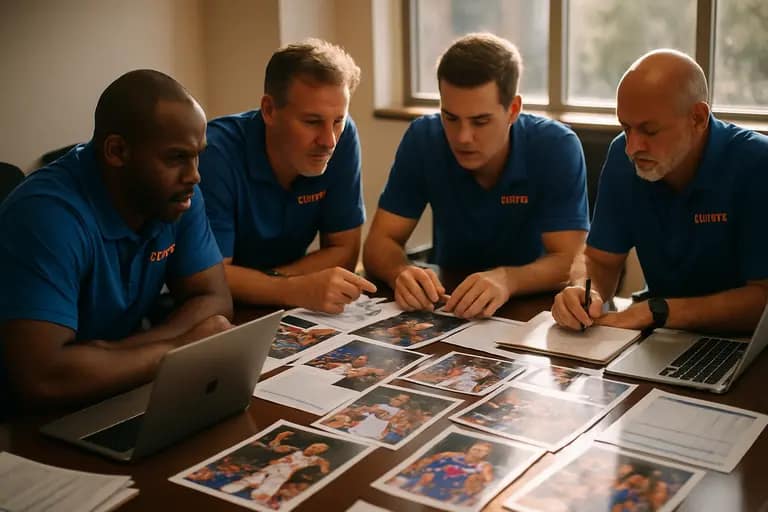
From Gainesville Principles To NBA Roles
Florida basketball fans tend to appreciate the part of the sport that happens before the highlight. A player earns trust by defending the right action, spacing without demanding the ball, and accepting a role that fits the group. That is why NBA continuity data lands with this community. It tells us which teams may already have a shared rhythm and which teams must create one under pressure.
When former college players reach the NBA, their value often depends on how quickly they read a room. Can they join a rotation without slowing the offense? Can they guard within a new coverage plan? Can they handle a smaller or larger role than they had before? These are not abstract ideas. They are the same developmental markers coaches stress from the college floor to the pro practice gym.
This is also why Gators fans should watch team context, not just individual talent. A player on a stable roster may find clearer minutes because the group already knows its hierarchy. A player on a reworked roster may face more competition but also more openings. Both situations can help a career, but they ask for different skills.
Why Community Fans Notice Chemistry
Fans in Gainesville and across Florida have seen enough basketball to know that chemistry is not a slogan. It is the difference between a good pass and a late pass. It is the difference between a switch that works and a switch that leaves two defenders on one man. It is the difference between a bench unit protecting a lead and giving it back in three possessions.
That is why the 2026-27 continuity numbers offer a useful fan lens. They help explain why one team may look settled early while another looks talented but uneven. They also remind us that player development does not stop when a name reaches the NBA. The pro game keeps testing adaptability, and that test becomes sharper when a roster turns over.
Why Roster Changes Matter To Gators Fans
Roster Changes matter to Gators fans because they shape the NBA environments that former college players enter and the team stories supporters follow from afar. A stable roster can reward players who know how to fit. A shifting roster can reward players who learn fast and bring a clear skill. Neither path is easy, but both reveal who understands winning basketball beyond raw production.
The July 10, 2026 continuity snapshot framed the league in direct terms: the Lakers had the lowest continuity at 42% of returning minutes, while New Orleans led the high-continuity group at 93%, with San Antonio, Orlando, and New York close behind. For anyone raised on Florida’s player-development mindset, those numbers are more than offseason trivia. They are clues about coaching pressure, role clarity, and the speed at which a team can become connected.
As the 2026-27 NBA season unfolds, the smartest read is not just who changed uniforms. It is how quickly each group turns new names into dependable possessions. That is the part of basketball worth tracking from Gainesville to the pro floor.
