
Gators roster retention is not a slogan in Gainesville as September 5, 2026 approaches. It is the working plan behind Jon Sumrall’s first Florida roster: keep enough proven players to carry the locker room, then add enough new talent to raise the ceiling before the opener against Florida Atlantic.
I tend to judge a roster the way I judge an NBA rotation built from former Gators: who stays, who earns trust, and who can handle a new role without the whole structure shaking. Florida football enters the 2026 season with that same question. Sumrall did not inherit a quiet room. Florida retained 62 players from the 2025 roster and added 50 new players, including 29 transfers, 20 high school recruits, and one JUCO addition, as reported by The Alligator. That mix tells the story. This is not a full reset, and it is not a standstill. It is a rebuild with a spine.
Why Gators roster retention Sets The Base
Gators roster retention In Sumrall’s First Offseason
The most telling part of Florida’s offseason was not just the number of arrivals. It was the choice to protect a set of returners who already understood SEC speed, the daily demands in Gainesville, and the weight that comes with playing for a fan base that notices every snap. Sumrall prioritized five core players from the retained group: running back Jadan Baugh, receivers Vernell Brown III and Dallas Wilson, linebacker Myles Graham, and edge rusher Jayden Woods. That is a balanced group, spread across offense and defense, and it points to a staff trying to anchor each phase before asking newcomers to settle in.
That is the heart of Gators roster retention: keep players who already have influence, then let the rest of the room learn through competition. The Gators have new faces, but the retained core gives practice a standard. In basketball terms, it is like keeping the veteran guard who knows the late-game call and the big who knows every defensive coverage. Football has more bodies and more moving parts, but the principle is the same. Continuity lowers the cost of teaching.
The Five Players Florida Chose To Build Around
Baugh brings production. In 2025, he rushed for 1,170 yards and eight touchdowns on 220 carries, with 31 catches. That gives Florida a known piece in the backfield while transfer Aaron Philo takes over as QB1 after arriving from Georgia Tech. Brown III and Wilson give the passing game retained receivers who were central enough to be named in the core group. Graham gives the defense its tackle leader from 2025, and Woods gives the front a returning pass-rush piece after co-leading the team with 3.5 sacks in 2025.
The preseason recognition matters, too, because it shows that this is not just internal optimism. Baugh was named second-team Preseason All-SEC for 2026, while Brown III and Woods were third-team selections. Those honors do not win snaps in September, but they confirm that Florida kept players with league-wide respect. For a first-year staff, that matters. A new coach can teach faster when the players carrying the message already have standing in the conference.
Linebacker Continuity Shapes The Defense
Returning Snaps Give Florida A Starting Point
The clearest example of retention is at linebacker. Florida returns roughly 1,605 of 1,641 snaps from the 2025 linebacker unit, about 98 percent of the positional production, according to the official Gators linebacker preview. That is the kind of number coaches usually hope for at quarterback or offensive line, not always at a position built on collisions and weekly adjustments.
Graham sits at the center of that continuity after leading the team with 76 tackles in 2025. Jaden Robinson and Aaron Chiles also return as key pieces in the room. The value here is not just that Florida has names back on the depth chart. It is that linebackers are the traffic cops of a defense. They fit the run, react to motion, communicate checks, and often set the tone between the defensive front and secondary. If those players already know each other’s habits, the defense can play faster before the first month turns into a teaching lab.
Where The Defensive Front Still Needs A Lift
Retention does not erase the need for growth. On the defensive line, Florida returns 57 percent of its defensive-line snaps from 2025. Of 21 listed edge and defensive-line players, 13 are returners. That is enough to avoid starting from scratch, but the Gators still added newcomers with the aim of improving pass rush and run defense after those areas lagged in 2025.
Woods is the name to watch up front. As a sophomore lineman in 2026, he is expected to anchor the defensive front after playing 448 snaps in 2025. He co-led the team with 3.5 sacks and ranked third among linemen with five tackles for loss. His Preseason All-SEC status adds another layer. Florida is not asking him simply to be a young contributor. The roster math asks him to be a stabilizer while the new pieces fight for jobs around him.
How Offensive Stability Meets A New QB1
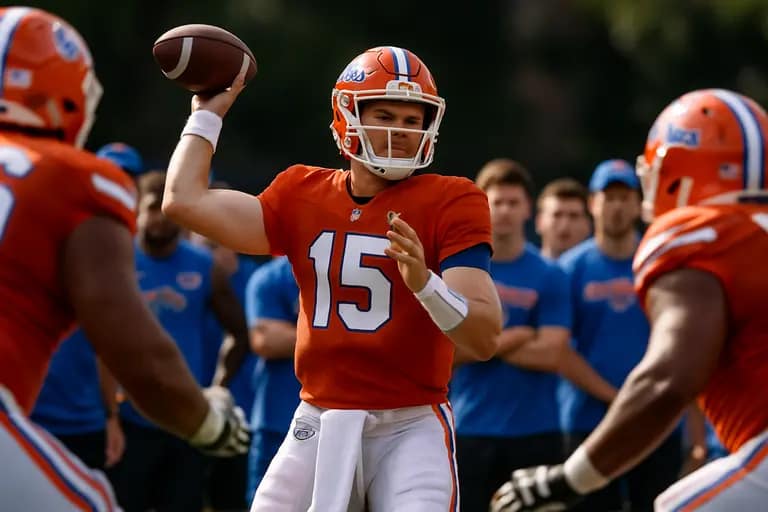
Jadan Baugh Gives The Offense A Reliable Entry Point
A new quarterback changes the feel of an offense, even when the staff has confidence in the choice. Philo has been named QB1 and has taken the bulk of first-team snaps while preparing for the September 5, 2026 opener against Florida Atlantic. Sophomore Tramell Jones Jr. remains the backup and is still in the mix. That gives Florida a named starter without pretending the room is closed forever.
Baugh’s presence makes that transition easier. A 1,000-yard rusher with receiving production gives a quarterback a cleaner way into games. Florida can lean on the run, use Baugh as a pass-catching outlet, and keep the offense from putting every early-season answer on Philo’s arm. Brown III and Wilson matter in the same way. Returning receivers help a new quarterback learn timing, spacing, and trust under game pressure.
What The Spring Game Already Showed
The April 10, 2026 Orange & Blue Spring Game came before the depth chart settled, but it served as a public checkpoint for Sumrall’s roster build. The identity was already shifting. New faces were present, yet the staff’s emphasis on retained experience was clear enough to frame the summer. By September 2, 2026, the plan is no longer abstract. Florida has a retained core, a named quarterback, and a defense with strong linebacker continuity.
For the Gainesville community, that matters beyond a depth chart. Fans have spent the offseason learning a new staff, new transfers, and new expectations. Retained players give the program familiar entry points. Families in the stands know Baugh’s runs, Graham’s tackling, and Woods’ edge presence. That connection is part of college sports. It helps a roster feel less temporary, even in an era with heavy player movement. The same idea of keeping a workable core has mattered across Gainesville sports, including recent discussion of Gators roster stability.
What Gators roster retention Means Before September 5
The question before Florida Atlantic is not whether Florida has changed. It has. Fifty new players make that clear. The better question is whether the retained players can speed up the change instead of getting swallowed by it. That is where Sumrall’s first roster strategy becomes interesting. He kept a strong enough group to set standards, then used transfers and recruits to raise competition across the board.
If Gators roster retention becomes one of the defining traits of the 2026 team, it will show first in the least glamorous moments: linebackers fitting the right gap, a back picking up pressure, a receiver breaking off a route at the right depth, and a defensive lineman holding contain when the opener gets tense. Those details decide whether a roster with 62 returners and 50 additions can look connected by kickoff. For Florida, the retained core is not just who stayed. It is the bridge between the 2025 roster and the team Sumrall is trying to put on the field on September 5, 2026.
