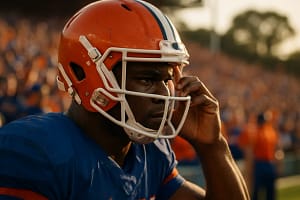
Gators Roster Depth has become the central Florida football question after a fast offensive start and before the grind of SEC play sorts out which strengths are real and which spots still need proof. This is not a roster with one simple answer. Florida has skill talent, returning linebackers and a running back who has opened the 2026 schedule like a man running downhill through unlocked doors. It also has pressure points in the trenches and enough secondary questions to keep a coaching staff honest.
That tension is what makes this roster so interesting for Gainesville. Championship-level teams are rarely built only on starters. They are built on the second guard who survives a road fourth quarter, the backup linebacker who fits the run without panic, the young corner who holds up after an injury, and the quarterback room that does not crack when the SEC schedule starts asking harder questions.
Gators Roster Depth Faces SEC Proof
How Gators Roster Depth Starts At Quarterback
Florida made its quarterback pecking order clear before the opener. On Aug. 24, 2026, the program announced Aaron Philo, a third-year transfer from Georgia Tech, as the starting quarterback ahead of the Sept. 5 opener against Florida Atlantic, with his Georgia Tech line listed at 59 completions on 102 attempts for 938 yards, two touchdowns and three interceptions team announcement. That mattered because Florida was not merely picking an arm. It was picking the player tasked with organizing a deep skill group behind a line that had to replace important pieces.
Sophomore Tramell Jones Jr. remained the top backup in the research notes and was described as a likely rotational threat. That gives Florida a different kind of security. A backup quarterback with movement ability can change a series, steal a possession or force defenses to prepare for more than one rhythm. But in SEC games, quarterback depth is not only about talent. It is about protection calls, third-and-long composure and avoiding the loose throw after a hit.
The Schedule Has Already Raised The Stakes
The Sept. 19, 2026, Auburn game had already arrived by the date of this analysis, and the available research did not provide a verified final score. What can be said safely is that Florida’s early schedule placed SEC pressure close to the front of the campaign. The notes also said five of Florida’s first six-game stretch sat in SEC territory or around SEC competition, which is a hard way to test backups before a roster fully settles.
That is where Gators Roster Depth moves from message-board talk to football reality. A team can look clean against early competition and still learn new truths once the line of scrimmage gets heavier, tackling windows shrink and special teams field position starts to feel like a tax.
Offense Has Playmakers, Trenches Need Answers
Baugh Gives Florida A Real Foundation
Junior running back Jadan Baugh is the strongest early argument that Florida has more than a pretty passing chart. Through the first two games of 2026, he had rushed for 296 yards, averaged 10.6 yards per carry and ranked fifth nationally in rushing yards, according to the research notes. He had also been named to preseason All-American, Maxwell and Doak Walker watch lists. That kind of production gives a quarterback breathing room and gives a play-caller a way to stay out of desperate football.
Still, the running back room cannot answer every concern by itself. A great back can cover a missed block once. He cannot cover a month of SEC fronts living in the backfield. Florida’s run game will tell a fuller story once it has to keep producing after opponents sell out to stop it.
Receiver Depth Offers Options
The receiver group has names that should matter: Dallas Wilson, Vernell Brown III, Micah Mays Jr., Eric Singleton Jr. and TJ Abrams. That is a healthy menu of profiles for a staff trying to stretch defenses horizontally and vertically. The research noted that Singleton was questionable for the Auburn matchup on Sept. 19 because of an ankle injury, which is exactly the kind of weekly variable that tests whether a deep room is truly deep.
The best case for Gators Roster Depth on offense is clear. If the receivers stay varied, Baugh keeps forcing extra defenders near the box and Philo manages the game without reckless turnover swings, Florida can make defenses defend grass from sideline to sideline. The question is whether the offensive line can give that design time to breathe.
That is the largest offensive concern. PFF’s 2026 Florida preview noted that the Gators lost their three highest-graded starting offensive linemen from 2025, creating uncertainty in both pass protection and run blocking PFF preview. In the SEC, that is not a footnote. That is the whole conversation some Saturdays. Skill depth matters, but line continuity often decides whether the playbook stays open or shrinks by halftime.
Defense Carries Experience And Questions
Linebackers Bring The Cleanest Continuity
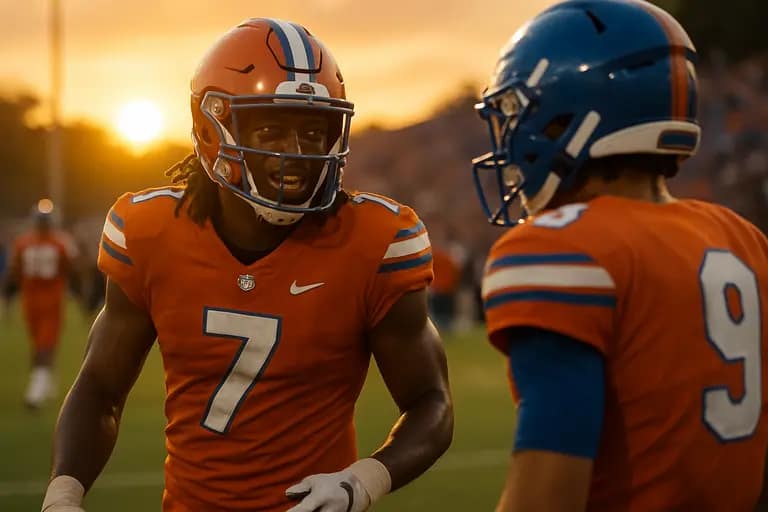
Florida’s linebacker room is the most stable defensive case. The research notes said the Gators returned about 98 percent of their linebacker snaps from 2025. Myles Graham led the team with 76 tackles, while Jaden Robinson and Aaron Chiles formed part of the experienced starting group. Sophomores such as Ty Jackson and Myles Johnson were also listed as depth pieces.
That matters because linebacker play connects the front to the secondary. If the defensive line gets moved, linebackers must erase space. If the secondary plays young players, linebackers must make the underneath windows messy. In the best version of this defense, that returning production becomes the unit’s stabilizer.
Secondary And Edge Depth Need More Proof
The secondary had promising names and mixed signs in the research. Safety Bryce Thornton brought 131 career tackles, while Cormani McClain and cornerback Ben Hanks III were expected to start. Underclassmen Caraway Jr. and Lagonza Hayward were listed as depth options. The concern is not whether there are players. It is whether the less experienced players can handle early SEC stress without giving away explosive plays.
Through three games, the research notes listed Florida at 231.7 passing yards allowed per game, 98th in FBS, while the rush defense was stronger at 94.7 yards allowed per game, 28th. That split is revealing. Florida has shown the ability to hold up against the run, but SEC passing games will keep testing communication, leverage and tackling in space.
The defensive line and edge group also sits in the prove-it category. Caleb Banks returned as a senior on the defensive line, and Tyreak Sapp was noted as a key edge returner. Depth beyond them was less certain in the research, putting pressure on younger players to help sustain tackles for loss and sack production. If Florida cannot rotate up front, good early defensive possessions can turn into tired fourth-quarter drives.
- Best-supported strength: running back production and linebacker continuity.
- Most urgent offensive question: replacing high-grade offensive line play from 2025.
- Most urgent defensive question: pass defense stability against SEC receiving rooms.
- Most important depth test: young players in the secondary and defensive front earning trust.
What Gators Roster Depth Means For SEC Saturdays
The answer is not a simple yes or no. Florida looks ready to stress teams with its skill talent, especially if Baugh continues giving the offense a reliable rushing identity. The quarterback room has a defined starter and a backup with rotational value. The receivers give the staff options. The linebackers give the defense a veteran middle. Those are real assets, not decoration.
But SEC readiness is measured in weak spots. Offensive line turnover can turn a balanced offense into a hurried one. A secondary with talent but uneven early numbers can become the target of every coordinator on the schedule. A defensive front with questions behind the headline returners can wear down if the rotation does not grow quickly.
For Florida’s community, this is the kind of roster story that reaches beyond one depth chart. Gainesville understands that depth is not glamorous until it saves a season. The same program-wide conversation has been part of how fans think about continuity across sports, including Florida’s 2026-27 core, because winning programs are shaped as much by their eighth and ninth options as by their stars.
Gators Roster Depth has enough strengths to survive strong SEC competition, but the margin sits in the trenches and back end. If the line play steadies and the secondary grows up quickly, Florida can turn a promising opening profile into something tougher. If not, the SEC will find the thin spots and keep pressing them until Florida proves it has answers.
