
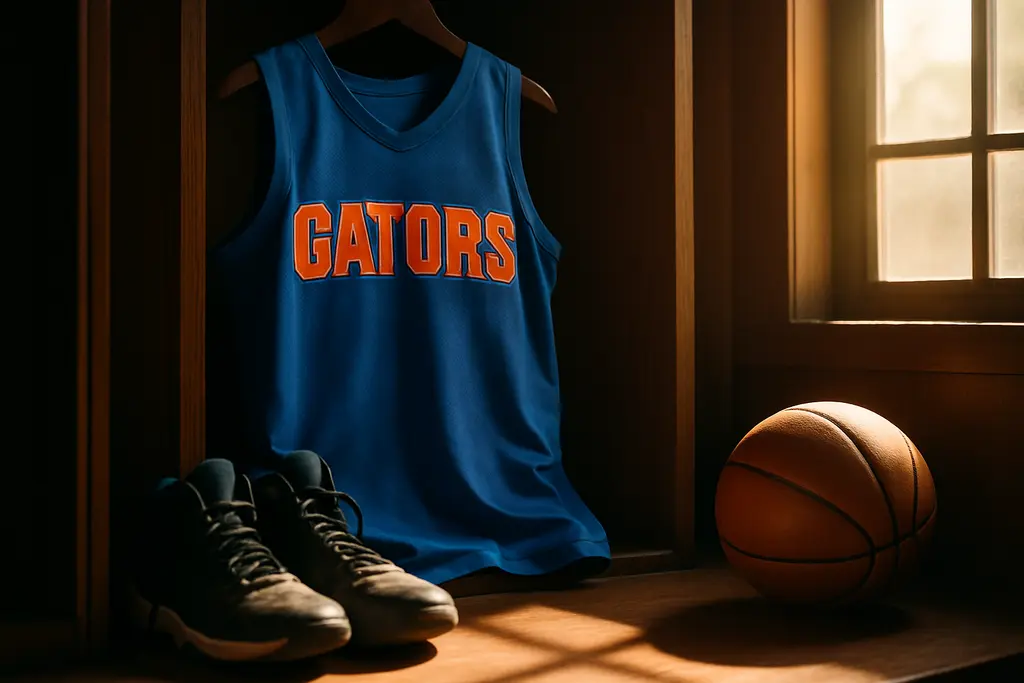

The Gators Backcourt discussion changed by October 6, 2026, because Florida had two guards with very different college paths sharing the same Gainesville floor: Denzel Aberdeen, the returning fifth-year senior, and Boogie Fland, the former Arkansas guard who already had one full Florida season behind him. For a program that has long measured guards by poise, defense, and March usefulness, this pairing is less about star labels and more about how two ball-handlers can shape tempo, spacing, and late-clock trust.
I tend to view Florida guards through a historical lens. The best ones did not always arrive as finished products. Some had to wait behind older players. Some had to learn that a good possession can be a ball reversal, a defensive stand, or a paint touch that leads to someone else’s shot. Aberdeen and Fland fit that older Florida standard in separate ways. Fland brings primary creation and pressure defense. Aberdeen brings age, shot-making, and the memory of prior Florida minutes before his one-season stop at Kentucky.
Gators Backcourt Roles On October 6, 2026
How The Gators Backcourt Shares The Ball
This Gators Backcourt pairing starts with one clear contrast. Fland has already shown he can handle a large on-ball workload. After transferring from Arkansas to Florida in summer 2025, he started all 35 games for the Gators in 2025-26 and averaged 11.6 points, 3.5 assists, and 2.5 rebounds with 61 steals, according to his Florida roster bio. That is the profile of a guard trusted to initiate offense while still being asked to disrupt the first pass on defense.
Aberdeen’s profile is different. He is a fifth-year senior who began at Florida from 2022-25, moved to Kentucky for 2025-26, then re-enrolled at Florida in May 2026, according to the supplied research. At Kentucky, he started 35 of 36 games while averaging 13.5 points, 3.4 assists, and 2.5 rebounds and shooting 36.3 percent from 3-point range. That matters because Florida does not need him to copy Fland. The cleaner fit is Aberdeen as a combo guard who can play beside a creator, punish help defense, and take over secondary actions when the first option stalls.
| Guard | Recent College Context | Best-Supported Role |
|---|---|---|
| Boogie Fland | Started all 35 games for Florida in 2025-26 | Primary handler, creator, point-of-attack defender |
| Denzel Aberdeen | Started 35 of 36 games for Kentucky in 2025-26 before returning to Florida | Combo guard, shooter, secondary creator, veteran stabilizer |
Defense Sets The First Line
Fland’s defensive ceiling gives Florida a starting point. His 2025-26 season included a game against No. 23 Alabama in which he matched a Florida single-game record with eight steals while also recording 15 points, eight assists, and one turnover. That line is rare because it mixes aggression with ball security. A guard can gamble for steals and wreck a team’s defensive shape. Fland’s best version pressures the ball without turning the back line into a fire drill.
Aberdeen’s defensive value is tied more to experience and assignment discipline. The supplied research does not provide a full defensive statistical profile for his Kentucky season, so any sweeping claim would go beyond what is verified here. What can be said is that his age and college minutes give Florida another guard who has seen SEC pace, tournament possessions, and the demands of playing through scouting reports. That matters when a guard rotation is asked to defend without fouling and then organize the next offensive trip.
Aberdeen’s Return And Fland’s Second Florida Year
Aberdeen’s Gainesville Arc
Aberdeen’s return carries weight in Gainesville because his story did not begin with instant control of the offense. During his first three seasons at Florida, he appeared in 83 games with five starts, totaling 426 points, 101 rebounds, 80 assists, and 31 steals. In 2024-25, he averaged 7.7 points across 39 games and produced back-to-back 20-point games, one at No. 22 Mississippi State and another against South Carolina.
There was also the March 2024 SEC Tournament semifinal performance against Texas A&M, when Aberdeen scored 20 points while going 6-for-9 from the field, 4-for-5 from 3-point range, and 4-for-4 at the free-throw line. The exact date within March 14-16 was not specified in the research, so the safer historical marker is the round and event. The larger point is clear: Aberdeen has already had tournament moments in a Florida uniform. That gives his return a community angle. Fans are not learning him from scratch. They remember the reserve who could tilt a game when the rotation needed a lift.
For readers tracking how his return affects the guard room, our related piece on Denzel Aberdeen’s return connects that move to Florida’s wider backcourt balance.
Fland’s Transfer Path
Fland’s road to Gainesville came through Arkansas. In 2024-25, he averaged 13.5 points, 5.1 assists, and 3.2 rebounds across 21 games, including 18 starts, with a 3.72 assist-to-turnover ratio. The research also notes that he missed about two months that season because of a thumb injury and had a hernia that affected him entering Florida’s fall preseason. By 2025-26, he was still durable enough to start every Florida game.
The shooting question is part of his evaluation. ESPN’s player page identifies Fland as a Florida guard and lists his statistical profile, including the outside shooting context that left his 2025-26 3-point percentage around 24 percent in the research notes ESPN player profile. That number does not erase his value, but it does explain why Aberdeen’s shooting can help the partnership. If Fland bends the defense off the bounce, Aberdeen’s catch-and-shoot threat gives the possession a cleaner second step.
From College Guards To Pro Questions

What Travels To The Next Level
The Gators Backcourt has a pro-angle hook, but it should be handled with care. The supplied research does not include verified NBA draft projections for Aberdeen or Fland. So the honest analysis is about transferable traits, not draft promises. Fland’s passing, steal production, and ability to start 35 games in an SEC championship season give evaluators a body of work built around responsibility. Guards who can organize a team and defend the ball usually get longer looks because those skills travel across systems.
Aberdeen’s case is built on age, shooting, and adaptability. He has been a reserve at Florida, a starter at Kentucky, and a returning veteran at Florida. That path can be messy on paper, but from a basketball historian’s seat, it shows a player who has had to survive role changes. Professional teams often ask young guards to accept uneven minutes, defend, and make open shots. Aberdeen’s 36.3 percent 3-point shooting at Kentucky in 2025-26 is the cleanest statistical marker in that discussion.
What Remains Unsettled
The unresolved part is usage. If both guards are on the floor, Florida has to decide who starts possessions, who closes them, and how much off-ball movement each accepts. Fland’s best work comes with the ball in his hands. Aberdeen’s value rises when he can space, attack a tilted floor, or steady a second unit. That is not a conflict by itself. It becomes a problem only if the offense gets static and one guard spends too many possessions watching the other operate.
The other question is defensive pairing size and matchup selection. The research supports Fland’s steal production and Aberdeen’s offensive record, but it does not give enough verified detail to declare how Florida will assign them against every SEC opponent. What we can say is that a two-guard look built around pressure, shooting, and veteran decision-making gives Todd Golden practical options. He can speed the game with Fland, settle it with Aberdeen, or use both to keep the ball in experienced hands.
Why Aberdeen And Fland Matter In Gainesville
A Backcourt Story With Local Weight
For Gainesville, the Gators Backcourt is not just a depth chart item. It is part of how Florida basketball keeps its identity visible in a state where football usually takes the first breath of every sports conversation. Aberdeen connects the present roster to earlier Florida seasons. Fland connects the program to transfer-era guard building, where a player can arrive from another SEC school and become central right away.
The pairing also gives Florida fans a clean way to read the 2026-27 team before results define it. Watch who brings the ball up after dead balls. Watch who guards the opponent’s lead creator. Watch whether Aberdeen’s shooting creates room for Fland’s drives. Watch whether Fland’s defense creates transition chances that let Aberdeen play before the defense sets. Those details are where guard partnerships are built.
Historically, Florida’s best teams have trusted guards who could handle pressure without turning every trip into a solo act. Aberdeen and Fland have enough verified production to make that standard relevant again. The next chapter is not about hype. It is about whether two different college paths can meet in one rotation and give Gainesville a backcourt sturdy enough for SEC pressure and visible enough for the pro conversation.