
Before he became a legend, Billy Donovan was just a kid from Long Island. He had a brief time in the NBA, playing for the New York Knicks in 1987. It was a time of big hair and big dreams.
But Donovan’s true talent wasn’t in playing. It was in coaching. He learned from Rick Pitino at Kentucky, getting ready to change basketball.
Those early years shaped his coaching style. It would later transform Florida basketball. It’s a story of 80s style and the rise of a coaching genius.
Hiring at Florida
Jeremy Foley took a big risk by hiring a young coach named Billy Donovan. The Florida Athletic Director saw a basketball program that was barely noticed. It seemed like a Division I team in name only.
In 1996, Gainesville was all about Steve Spurrier’s football. The O’Connell Center was almost empty during basketball games. Fans were few, and the program’s dreams seemed small.
Foley saw something special in this 30-year-old from Marshall. He saw vision where others saw danger. Donovan promised to bring success, unlike the previous florida basketball coach.
Donovan didn’t just apply for the job; he envisioned a future. He convinced the administration that basketball could win championships too. His plan was to change the athletic culture.
This hiring was like choosing an indie film director for a big movie. Would Donovan’s approach work on a bigger stage? Or would basketball stay in football’s shadow?
That 1996 choice did more than just hire a new florida basketball coach. It started a remarkable change in college basketball. Foley’s decision was not crazy; it was a smart move.
Building a Program
Donovan built Florida basketball like a master craftsman building a cathedral. Each season added a new stone to the foundation. Each recruit was like a stained-glass window in the masterpiece.
The early years were tough. How could he sell basketball at a football powerhouse? Donovan had to show players that orange and blue meant more than touchdowns. He had to build belief where none existed.
His coaching philosophy was unique. While others chased one-and-done talent, Donovan focused on four-year players who actually improved. It was like opening a farm-to-table restaurant in Fast Food Nation.
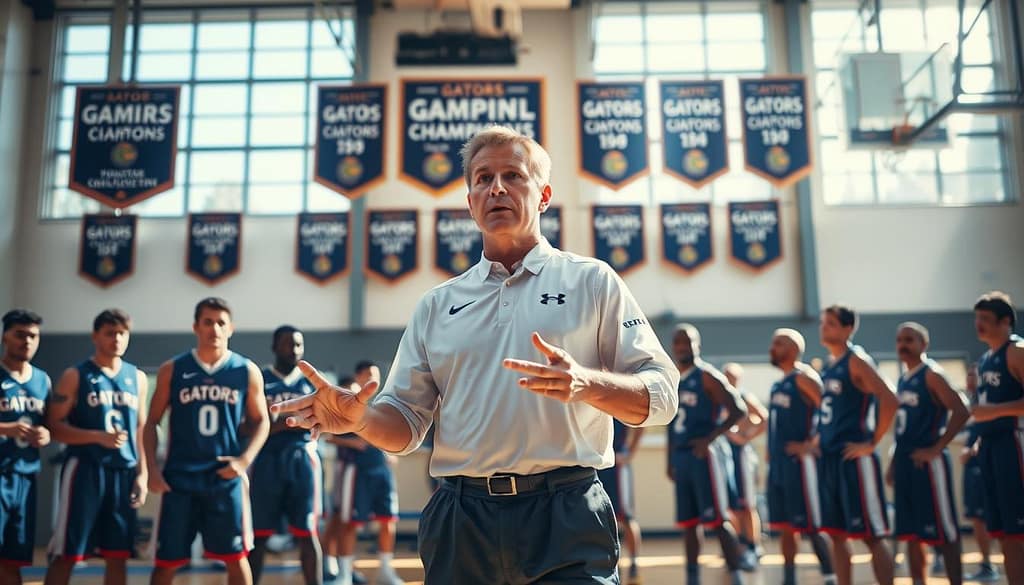
The breakthrough came in 2000 when Donovan’s Gators reached their first national championship. They lost to Michigan State, but the message spread. The sleeping giant in Gainesville had awakened.
Donovan’s system had three core principles:
- Player development over quick fixes
- Team chemistry above individual stats
- Cultural sustainability over temporary success
This approach created something rare in sports: continuity. Players stayed and grew. They bought into something bigger than themselves. The Billy Donovan Gators were known for fundamental excellence, not just highlights.
His program building was like intellectual architecture. Donovan designed systems where everyone thrived. He showed that patience could build empires in an era of instant gratification.
The transformation of Florida basketball under Billy Donovan is a case study in cultural engineering. He didn’t just win games; he built an institution that would last long after any season or player.
Offensive/Defensive Philosophy
Billy Donovan was a chess master in basketball. His strategy was not just balanced but a beautiful mix of chaos and order. It left opponents stunned.
The Florida basketball coach made defense a core part of his team’s identity. His teams didn’t just defend; they suffocated opponents with precision.
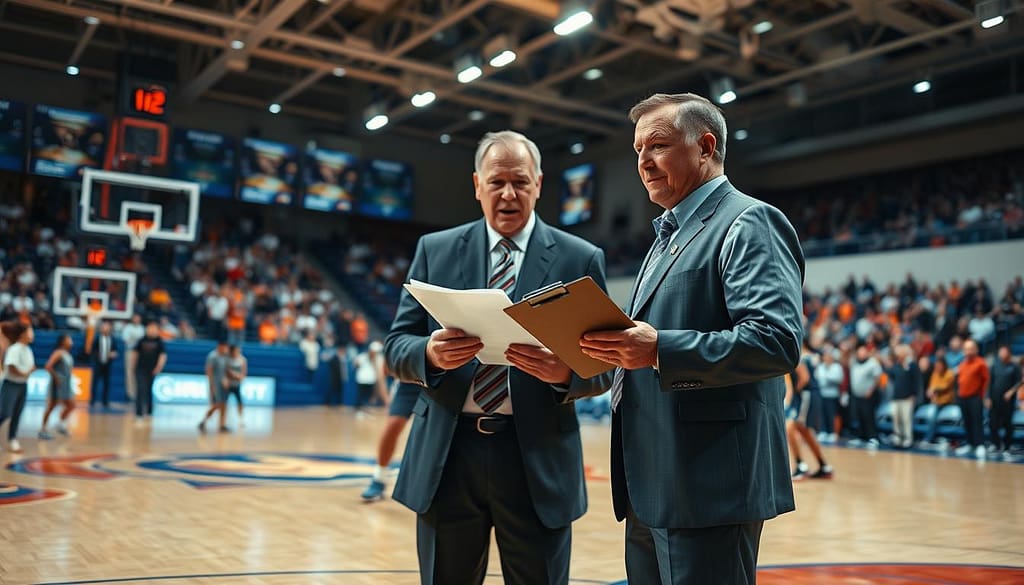
Donovan’s defense was like a well-oiled machine. His teams applied pressure on the perimeter and had help defense that moved in sync. Big men protected the rim like bouncers at a club.
But his offense was the perfect counter. It added the fireworks to the defense’s foundation. Donovan’s teams could beat you in many ways, like a Swiss Army knife.
The 2006 and 2007 teams showed this philosophy in action. Noah, Horford, Brewer, and Green each played a key role. They worked together like a well-oiled machine.
Donovan’s offense was like jazz, structured yet flexible. The ball moved with purpose, and players cut with precision. Every possession was a choreographed dance.
| Philosophy Component | Defensive Approach | Offensive Strategy | Player Development Focus |
|---|---|---|---|
| Perimeter Game | Pressure defense | Ball movement | Shooting accuracy |
| Interior Play | Rim protection | Post scoring | Footwork development |
| Transition | Getting back quickly | Fast break execution | Conditioning |
| Half-court Sets | Positional awareness | Screen utilization | Basketball IQ |
Donovan’s system was special because everything connected. Defense led to offense, and offense allowed defense to rest. Players kept improving in both areas.
This was not just coaching; it was basketball alchemy. Donovan transformed raw talent into championship gold. His philosophy showed that harmony, not extremes, leads to the best results.
Donovan’s approach made players better. His system didn’t just win games; it created complete basketball players who understood the game deeply.
In the end, Billy Donovan’s philosophy was about more than X’s and O’s. It was about creating a culture where defense and offense were two sides of the same coin.
Recruiting Mastery
Billy Donovan focused on three-star players, unlike others who chased five-star recruits. His method was smart and different from the usual rush in college basketball.
Donovan played a long game, unlike the quick wins of others. While John Calipari collected top talent, Donovan looked for players to grow. He wanted players who would improve, not just those already good.
Casey Prather’s story is a great example. He went from 1.2 points per game as a freshman to 14.1 as a senior. This shows Donovan’s system worked well. Scottie Wilbekin also grew from a backup to SEC Player of the Year under Donovan.
Donovan believed in waiting for the right players. In a time of one-and-done stars, he built lasting success through player growth.
| Development Approach | One-and-Done Approach | Long-term Impact |
|---|---|---|
| 3-4 year player development | Single season rental | Sustainable program culture |
| Fundamental skill building | Immediate talent utilization | Lasting player improvement |
| System continuity | Annual roster overhaul | Consistent performance |
| Relationship building | Transactional recruiting | Loyal alumni network |
Donovan promised recruits they would get better, not just be better prospects. He talked about growth, not just getting drafted. Players wanted to be part of something bigger than themselves.
The results were amazing. Donovan’s teams made multiple Final Fours and won back-to-back championships. He also developed many NBA players over years, not months. This is the legacy of the Billy Donovan Gators – building greatness slowly in a world that wants quick fixes.
Donovan’s success wasn’t about getting the biggest names. It was about finding the right players and watching them become amazing. In the end, the developer outlasted the collectors.
Setting the Tone for Decades
Billy Donovan didn’t just coach basketball at Florida – he changed its DNA. Before he arrived, Gainesville was all about football. Now, the arena buzzes with the same energy as the swamp. He built something lasting, beyond just trophies.
His coaching tree has spread across college basketball like kudzu. Coaches like Anthony Grant, Shaka Smart, and Donnie Jones grew from his innovative methods. Even his brief stint with the 2007 Orlando Magic showed his worth. He chose to stay, and Florida’s success continued.
The legacy of this Florida basketball coach goes beyond wins. It’s about the expectation of excellence. No one doubts Florida’s basketball prowess anymore. The culture shift is here to stay.
Donovan made an institution where process is key, not just results. His defensive strategies and recruiting vision set high standards. The best Florida basketball coach didn’t just build a team. He created an ecosystem that thrives to this day.
