
Before a certain coach arrived, Florida basketball was just a shadow of football. Then, everything changed.
When a football-dominant program turned to basketball, it was a game-changer. This led to one of college sports’ most amazing transformations.
The coach didn’t just win games; he changed the athletic culture. Through strategic recruiting and hard coaching, he made a middling SEC program a national powerhouse.
Winning back-to-back championships in Gainesville was like finding your accountant could win Olympic gold in figure skating.
This wasn’t just about winning trophies. It was about showing basketball could shine in The Swamp’s shadow. The cultural shift was truly amazing.
Arrival and Immediate Impact
Imagine stepping into a basketball program with low expectations. That’s what Billy Donovan found in 1996. The Florida Gators were coming off a 12-16 season, moving slow like dial-up internet.
Donovan, just 31, brought Wall Street smarts and Rick Pitino’s basketball know-how. He wasn’t a young dreamer. He was a Pitino protégé ready to rebuild with strategy and business acumen.
The first two seasons were tough. The Gators went 13-17, then 14-15. But Donovan was building his team. He introduced a fast, pressuring defense that made opponents feel like they were being chased.
Donovan excelled in recruiting. He found players who were eager to work hard. He convinced them that Florida could be a big player in basketball.
A quiet change began. Practices got longer, and expectations rose. Players learned to push themselves harder. They saw a coach who wouldn’t settle for anything less than the best.
By year two, the team was taking shape. They lost games, but they were close. The Gators were becoming tough, unpredictable, and hard to play against.
Donovan’s teams played with passion. They pressed, ran, and took shots that made fans cheer. It was chaotic, but exciting. The O’Connell Center was no longer a place opponents looked forward to.
The change wasn’t quick. But slowly, Florida found its identity. It wasn’t just getting a new coach. It was becoming a team with a clear direction.
Building a Championship Team
Billy Donovan didn’t just collect McDonald’s All-Americans. He built a culture. His team was like an orchestra, where every player knew their role.
Donovan’s recruiting was unique. He looked for character, not just talent. Players like Udonis Haslem and Mike Miller were more than just basketball players. They were the start of a remarkable turnaround.
The 1999 Sweet Sixteen run was a big statement. Florida basketball had arrived, thanks to Donovan’s leadership. He turned raw recruits into a team that played together like a well-oiled machine.
Donovan’s success came from three key areas:
- Psychological profiling – He knew players better than they knew themselves
- Skill transformation – He turned weaknesses into strengths through hard work
- Culture creation – He made a team environment where success came first
The 2000 championship game against Michigan State was a big moment. Nobody thought Florida would make it that far. Yet, they were there, playing for a national title just four years after Donovan started.
This success wasn’t by chance. It was the result of careful planning and leadership. Donovan was a psychologist, talent evaluator, and developer all in one. He turned raw talent into gold through hard work.
The foundation of Donovan’s success was the “Three Ds”:
| Component | Implementation | Result |
|---|---|---|
| Development | Daily skill work tailored to each player’s needs | Rapid improvement in fundamental skills |
| Discipline | Systematic approach to both offense and defense | Consistent performance under pressure |
| Dynamics | Creating roles that complemented each other | Seamless team chemistry and flow |
Haslem and Miller’s growth showed Donovan’s magic. They weren’t just improving – they were showing the power of a well-built system.
Donovan made it look easy. While others rebuilt, Florida developed. The team wasn’t built in one class – it was crafted over years.
This foundation was the key to Florida’s success. The 2000 title game was just the start of a dynasty.
SEC and NCAA Triumphs
The SEC became Florida’s personal fiefdom under Donovan. It was a basketball kingdom where six regular-season crowns were just the start. Donovan’s Gators treated the whole year like their own highlight reel.
Four SEC Tournament championships were just victory laps. Fourteen NCAA Tournament appearances were Florida’s annual spring vacation. The Gators didn’t just win games; they systematically dismantled conference morale.
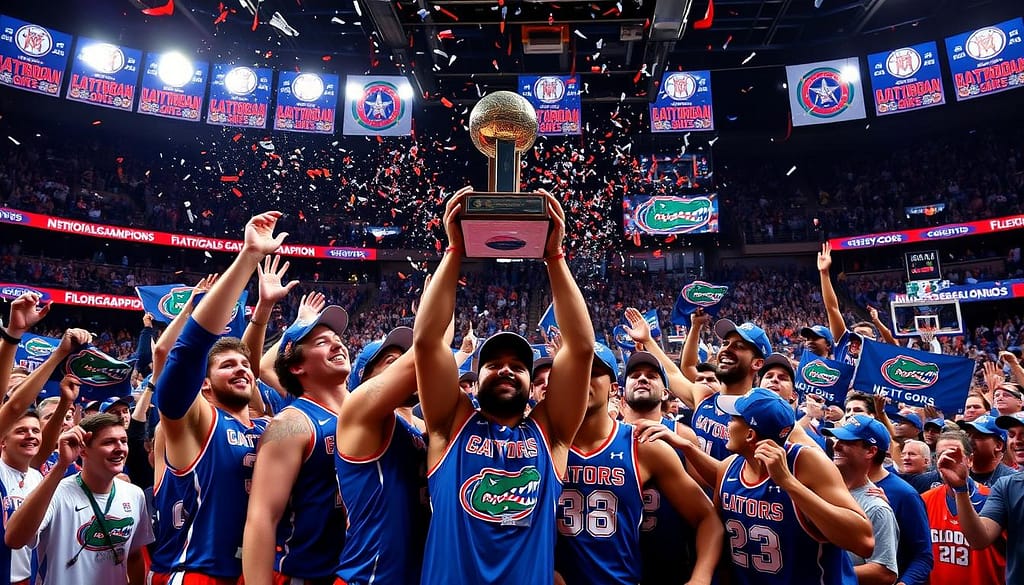
Donovan’s strategic genius was in building a machine that could win any game. His teams could out-run, out-shoot, or out-tough you, depending on the moment.
The blueprint was brutally effective:
- Regular-season dominance that sucked the hope from opponents
- Tournament adaptability that made every game plan obsolete
- Program depth that turned alleged “rebuilding years” into 25-win seasons
This wasn’t accidental success. It was systematic conference colonization. While Kentucky fans argued about tradition and Tennessee fans hoped for breakthroughs, Florida just kept collecting hardware.
The ultimate validation came with those back-to-back national titles. It was like winning the heavyweight belt and then defending it against all comers. Donovan had built something that could dominate locally and conquer globally.
Fourteen NCAA trips. Six SEC titles. Four tournament crowns. The numbers tell the story of a program that didn’t just have great seasons. It owned an entire era of Southeastern Conference basketball.
Player Development and NBA Success
Billy Donovan was different from other coaches. Instead of just looking for stars, he built a team in Gainesville. He turned raw talent into NBA-ready players, making Florida a basketball finishing school.
Joakim Noah went from a raw big man to a defensive star. Al Horford became a complete big man. Corey Brewer turned into a two-way NBA wing. Donovan’s system changed their basketball DNA.
Donovan’s method was clear: find strengths, grow them, and fix weaknesses. Players didn’t just do drills; they went through basketball therapy. This led to nine NBA players, with six being first-round picks.
This pipeline was a big draw for recruits. They saw not just championships but also a chance for professional growth. Florida offered a guaranteed path to professional development. It was more than winning; it was about growing careers.
The cycle of Donovan’s success was simple: develop NBA players, attract better recruits, and keep growing. It was about building careers and making Florida the top place for basketball talent.
| Player | Initial Skills | Developed Strengths | NBA Draft Position |
|---|---|---|---|
| Joakim Noah | Energy, length | Defensive IQ, passing | 9th overall (2007) |
| Al Horford | Post presence | Mid-range game, defense | 3rd overall (2007) |
| Corey Brewer | Athleticism | 3-point shooting, defense | 7th overall (2007) |
| Taurean Green | Ball handling | Leadership, clutch shooting | 52nd overall (2007) |
Pivotal 2006 & 2007 Runs
Winning one championship is tough. Winning two in a row is like catching lightning in a bottle twice. Yet, Billy Donovan made it look easy.
The 2006 run was more than basketball. It was a battle of wills. Donovan’s Gators faced UCLA, with six future NBA stars. That’s like facing an All-Star team in college.
Beating such talent required precision and smart game plans. Florida didn’t just win; they dismantled UCLA. They exposed UCLA’s weaknesses like a chess master spotting a flaw.
The 2007 title defense was a new challenge. Greg Oden and Ohio State were the favorites. Everyone thought they would easily win.
Donovan had a different plan. He forced Oden into tough spots and made Florida’s guards control the game. It was like David facing Goliath, but with a basketball strategy.
What made these wins special wasn’t just the victories. It was keeping the team together despite NBA offers. Donovan valued development over quick wins.
The 2006 and 2007 wins were not accidents. They were lessons in preparation, player management, and strategy. Billy Donovan didn’t just win; he changed college basketball.
National Recognition and Branding
Before Billy Donovan arrived, Florida basketball was a team nobody really noticed. They were football’s little brother, seen only on regional sports networks when football games were scarce.
Donovan changed everything. He didn’t just win games; he built a national brand. The back-to-back championships in 2006 and 2007 changed college basketball forever.
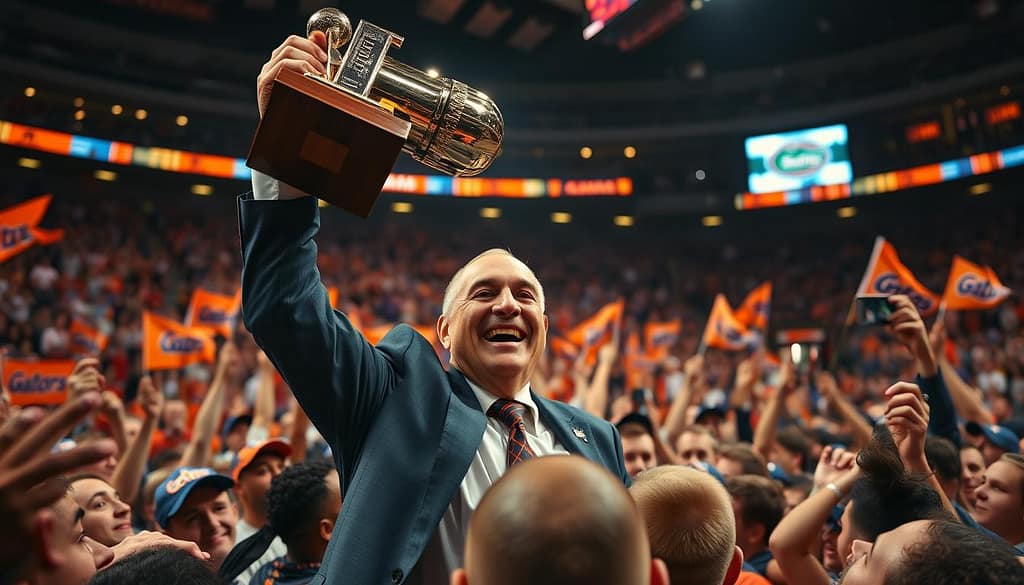
Orange and blue became more than just football colors. The change was immediate and deep. National media outlets started covering Florida basketball all the time. ESPN’s College GameDay became a regular visitor, and Florida basketball highlights filled SportsCenter in March.
Merchandise sales soared, making the Gators logo famous. Recruiting changed too. Five-star prospects from all over were now considering Florida as seriously as top programs.
Donovan knew winning changes how people see you. And that attracts more resources to keep winning. The 2000 NCAA Tournament run showed what was possible. But the championships made it real.
Facilities got better, budgets grew, and Florida basketball became a top destination. The program became a source of pride for the whole university.
This transformation was fast. In less than a decade, Donovan turned a regional team into a national powerhouse. The program’s rise became a lesson in how leadership can change an athletic department’s image.
Donovan did more than win games. He created a culture of excellence. Florida basketball became must-see TV and a national topic. The real magic was in the sustained excellence that made people outside Florida care about basketball in Gainesville.
Coaching Style and Cultural Change
Billy Donovan didn’t just coach basketball – he conducted a symphony of controlled chaos. His approach was like watching a jazz master improvise within a classical structure. The fundamentals were non-negotiable, but the execution had room for creative brilliance.
Donovan’s defensive philosophy was simple yet brutal: constant pressure, intelligent switching, and relentless communication. He turned defense into offense faster than most teams could set up their half-court sets. The Gators didn’t just defend – they attacked defensively.
Offensively, Donovan’s system was the basketball equivalent of a Swiss Army knife. Multiple ball-handlers, versatile big men, and shooters everywhere. He built lineups that could beat you five different ways before halftime. The beauty was in its adaptability – if you took away one option, three others emerged.
But X’s and O’s were only part of the story. The real magic happened in practice. Donovan’s sessions were legendary for their intensity and attention to detail. He’d stop drills mid-play to correct foot positioning or defensive angles. Every repetition mattered. Every mistake was a teaching moment.
The cultural transformation was perhaps his greatest achievement. Donovan created an environment where:
- Accountability wasn’t punitive – it was expected
- Player development wasn’t optional – it was mandatory
- Team success always trumped individual stats
His leadership style created believers out of skeptics. Players bought in because they saw the results – in their games, their development, and ultimately, their championship rings. Donovan didn’t just coach basketball – he built men.
This cultural blueprint became so effective that it followed him to the NBA. When he took the Chicago Bulls head coach position, he brought the same philosophy: develop players, build culture, win the right way.
The true test of leadership isn’t just what you accomplish – it’s what you build that lasts after you’re gone. Donovan built a culture of excellence that became Florida basketball’s identity. He proved that with the right leadership, even a football school could become a basketball powerhouse.
His practice methods became the stuff of legend. Two-hour sessions that felt like four. Film study that revealed tendencies opponents didn’t know they had. Conditioning that left players exhausted but prepared for March’s grueling schedule.
Donovan’s in-game adjustments were equally impressive. He’d switch defenses mid-possession. He’d call timeouts not just to stop momentum, but to install new plays. His clipboard wasn’t just for drawing – it was for teaching in real-time.
The result? A program where excellence became the expectation. Where players didn’t hope to win – they expected to win. That cultural shift, more than any playbook, was Donovan’s masterpiece of leadership.
Exit, NBA Transition, and Lasting Influence
Billy Donovan’s move from Florida was like a magician disappearing – but the rabbit stayed and won. The 2007 Orlando Magic saga is a coaching legend. It shows even geniuses can make bad decisions.
He took the job, then quickly changed his mind. Sometimes, the best choice is not making one.
Donovan’s move to Oklahoma City in 2015 was a big test. Could his college success work in the NBA? The Thunder years showed his adaptability and the NBA’s challenges. He worked with stars like Russell Westbrook and Paul George.
Though he didn’t win back-to-back national titles, his results were good. He made playoff appearances and showed tactical genius.
Donovan’s lasting impact is his coaching tree. His former players now lead teams, using his defensive strategies and player development methods. They win with his playbook and add their own stories.
Donovan’s key idea is that culture is more important than talent. Florida’s success after he left shows his system was bigger than him. The Gators got a blueprint for future leaders.
Donovan’s remarkable legacy goes beyond wins and losses. It’s about creating a system that lasts long after you’re gone. His greatest trick was building a system that kept winning after he left.
Today, Donovan’s influence is seen in college and professional basketball. His coaching tree spans the NCAA, and his NBA innovations help teams develop young talent. The man who won back-to-back national titles showed legacy is about inspiring others long after you’re gone.
Donovan’s Place in NCAA History
Where does Billy Donovan rank in college basketball history? His Florida Gators dynasty wasn’t just about winning back-to-back titles. It was about changing what we thought was possible in the SEC, a football-loving territory.
Donovan’s approach to lasting success is worth comparing to Wooden’s UCLA and Coach K’s Duke. While those programs had a long history, Donovan built something huge from scratch. His dynasty was a testament to building basketball greatness in the swamp.
The numbers show his success: two national championships, three Final Fours, and four SEC Tournament titles. But the real magic was in developing players like Noah, Horford, and Brewer. They went on to NBA stardom while keeping the program strong.
Donovan’s impact goes beyond the championships at Exactech Arena. He created a blueprint for building programs in modern college basketball. His time showed that any school can achieve greatness with the right culture and development system, even in football-dominated areas.
In the end, Donovan didn’t just win games. He built an empire that changed our view of basketball in unexpected places. That’s a legacy that puts him among the coaching legends.
