
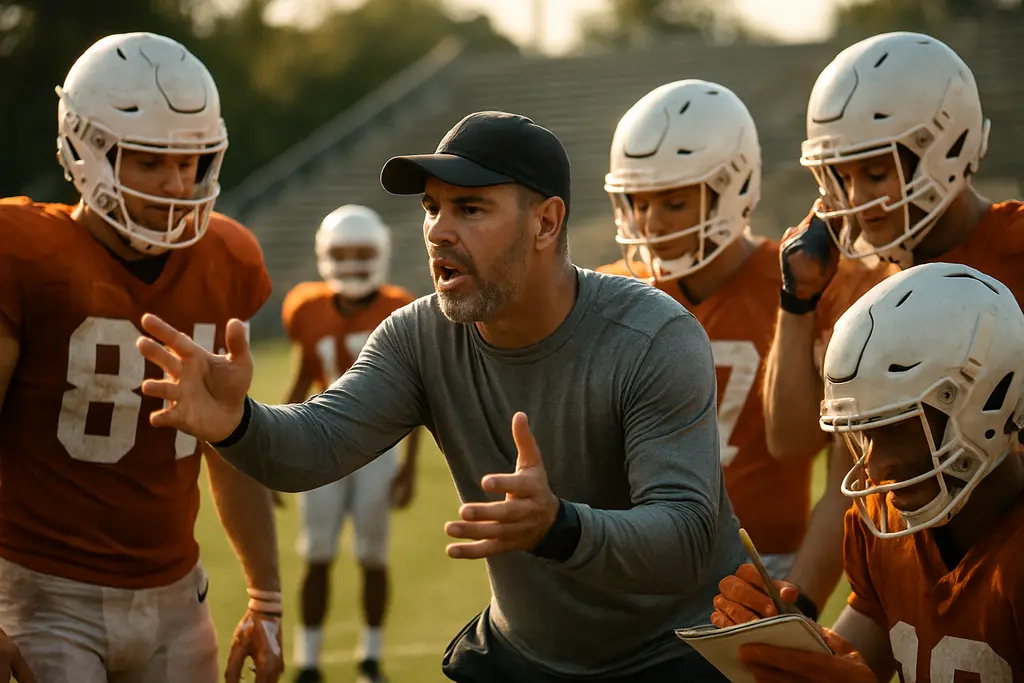

Gators Fall Practice became the first real proving ground for Jon Sumrall’s rebuilt Florida roster, and by late August 2026 the story had moved from roster math to football identity. The Gators were no longer just adding names; they were sorting roles, testing lineups and deciding which players could carry the daily strain of a program trying to reset its standard.
Florida’s roster change was not subtle. On February 4, 2026, the program officially welcomed 50 newcomers: 29 transfers, 20 high school recruits and one junior college transfer, according to the school’s newcomers announcement. That number framed everything that followed. Fall camp was less about polish and more about sorting trust, especially after the quarterback room changed shape with DJ Lagway’s departure to Baylor.
By the time Sumrall named Aaron Philo the starter on August 25, 2026, Florida had gained an answer at the most visible position. It had not gained every answer. The offensive line was still being tested through rotations, the receivers room was still blending returners with transfers and young talent, and the defense was still being pushed to finish plays that were nearly turnovers in the first scrimmage.
What Gators Fall Practice Revealed
Camp Was A Roster Audit
Fall camp often gets dressed up as a slogan season. In Gainesville, it functioned as an audit. Florida had to measure who could handle assignment football, who could stay on schedule and who could move from promise to dependable reps. That is the part of a rebuild that can feel quiet from the outside, but inside a facility it decides who gets trusted when the lights hit.
The first fall scrimmage on Saturday, August 15, 2026, gave the staff a broad look. Florida ran 127 total plays, with 50 coming from the first unit, 43 from the second and 34 from the third. That distribution mattered because it showed Sumrall was not only judging the top of the depth chart. He was also sorting the second wave and the developmental group behind it.
Only one interception was thrown in that scrimmage, by Philo, but the coaching review was not limited to the box score. Sumrall noted several turnover-worthy chances that the defense did not finish because of drops. That is classic camp tension: the offense avoided a larger mistake total, while the defense saw chances slip away. For a staff building a weekly standard, both sides left with teaching tape.
Practice Urgency Replaced Spring Guesswork
Gators Fall Practice put a sharper edge on areas Sumrall had flagged before the opener. Space tackling, procedural execution, delay-of-game situations and offsides were all part of the camp conversation. Those are not cosmetic details. In the SEC, a missed tackle in space can become a field-position swing, and a pre-snap penalty can turn a manageable down into a drive killer.
The offensive line and receiver groups carried special pressure because both units were still forming. The line had multiple rotations in play, and Sumrall indicated playing time would depend on consistency and performance, not just how a player fit a drawing on a board. That is the hard side of roster progression: talent gets you into the competition, but repeatable execution keeps you there.
For readers tracking football development across the site, the fall camp themes connected naturally with Gators Fall Practice accountability, where strength gains, speed testing and daily standards were part of the wider reset under Sumrall.
Quarterback Clarity Changed The Room
Gators Fall Practice And The Quarterback Room
Florida’s quarterback competition began with real stakes. With Lagway gone to Baylor, the room turned to Aaron Philo, a redshirt sophomore transfer from Georgia Tech, and Tramell Jones Jr., a redshirt freshman. The research from spring and fall practice indicated Philo had the early edge because of his familiarity with offensive coordinator Buster Faulkner’s system.
On August 25, 2026, Sumrall announced Philo as the starter for the season opener, which had been scheduled for September 5, 2026, against Florida Atlantic. The date matters because, as of October 20, 2026, that opener was no longer upcoming. The available research here does not include the game result, so the supported takeaway is limited to the camp decision: Florida left August with Philo as QB1 and Jones still receiving first-team reps as the primary backup.
That second part should not be skipped. Naming a starter can settle the huddle, but keeping the backup involved with top-line work protects a team from stagnation. It also keeps pressure in the room. Philo earned the first shot, but Jones remained part of the weekly development plan. For a new staff, that balance offered structure without shutting down competition.
Why Philo’s Edge Mattered
Philo’s advantage was not presented as a celebrity coronation. It was tied to system comfort. That distinction says something about Sumrall’s first Florida roster. The staff appeared to value players who could process, communicate and stay within the offense. In camp, a quarterback who understands the language of the coordinator can speed up everyone around him, from linemen setting protection to receivers adjusting routes.
Jones’ place in the room still gave Florida an important developmental thread. A redshirt freshman earning continued first-team reps after a starter was named suggests the staff wanted him ready and wanted the competition to retain some bite. That is how a program builds more than a depth chart. It builds a room capable of handling a long schedule.
Transfers And Returners Shaped The Core
The Newcomer Wave Needed Anchors
When 50 newcomers arrive in one cycle, the roster needs stabilizers. Florida had several returners positioned to serve that purpose, including running back Jadan Baugh, linebacker Myles Graham, edge rusher Jayden Woods and wide receivers Vernell Brown III and Dallas Wilson. Brown led Florida in 2025 with 40 receptions for 512 yards, as noted in The Washington Post preview.
That returning production gave the offense at least one known receiver while the rest of the room reformed. Florida’s receivers retained just over 36 percent of their 2025 snaps, according to the research. That kind of turnover can create opportunity, but it also demands fast teaching. The Gators supplemented the group with experienced transfers such as Eric Singleton Jr., Bailey Stockton and Micah Mays Jr., along with high-profile high school recruits.
There is a community angle here, too. Gainesville does not watch roster construction like a spreadsheet exercise. It watches to see who becomes recognizable on Saturdays, who connects with the student section, who grows into a name kids in North Central Florida repeat at practice. Brown’s production, Wilson’s return and the incoming receiver competition gave the fan base more than depth-chart drama. It gave the offense a set of personalities to follow.
Defensive Experience Had Real Value
On defense, Woods stood out in the research as a player with returning experience. He played all 12 games in 2025 and recorded 28 tackles, five tackles for loss and 3.5 sacks, along with a turnover and pass breakups. Under defensive coordinator Brad White, that background mattered because the front seven needed players who had already handled SEC physicality.
The first scrimmage also showed the defense had chances to make camp-altering plays. The dropped near-turnovers were not meaningless. Coaches often see those moments as proof of positioning and proof of the next assignment: finish the play. For Florida, those missed chances became part of the teaching plan as much as any completed pass or run fit.
Roster Progression Built A Championship Standard

Small Details Carried Big Weight
Championship programs are usually discussed through stars, banners and late-game heroics. In August, Florida’s work was far less glamorous. It lived in tackling angles, cadence discipline, receiver timing, offensive line communication and quarterback command. Those details do not make a highlight reel in camp, but they often decide whether a team can survive third-and-6 on the road.
Sumrall’s emphasis on urgency during the final weeks of camp fit the scale of the roster change. With transfers, freshmen and holdovers all learning new roles, Florida did not have the luxury of slow correction. Every practice rep had to help define who could play fast without playing loose.
- Philo gave the offense a named starter before the opener.
- Jones remained involved enough to keep the quarterback room competitive.
- The receiver room had to replace a large share of snaps while leaning on Brown and Wilson.
- The offensive line continued to sort rotations through performance.
- The defense had returning pieces, but camp tape showed finishing takeaways was still a priority.
That list is not flashy, but it is the skeleton of roster progression. The Gators were trying to move from collection to team. In a program with championship memories, that distinction matters. Talent can gather quickly through transfers and recruiting. Cohesion takes practices, scrimmages and uncomfortable grading sessions.
Why Gators Fall Practice Still Defines The Roster
Gators Fall Practice did not answer every question, and the available research does not provide verified results from the September 5, 2026 opener or the games after it. What it did provide was a clear camp portrait: Sumrall inherited a heavily changed roster, identified Philo as the first quarterback answer, kept Jones engaged, challenged the line and receivers, and leaned on returners to give the new pieces a standard to chase.
For Florida supporters, that is the real value of the August record. It shows how the roster was being built before the public scoreboards took over. The 50 newcomers gave Florida volume. Brown, Baugh, Graham, Woods and Wilson gave Florida continuity. Philo’s selection gave Florida a starting point. The unresolved rotations gave the staff pressure points to keep testing.
The championship angle is not that fall camp guaranteed anything. It is that every title-level team first has to prove it can practice with purpose. In 2026, Florida’s roster progression began with that daily test, one rep at a time, under a new head coach trying to set a harder edge in Gainesville.